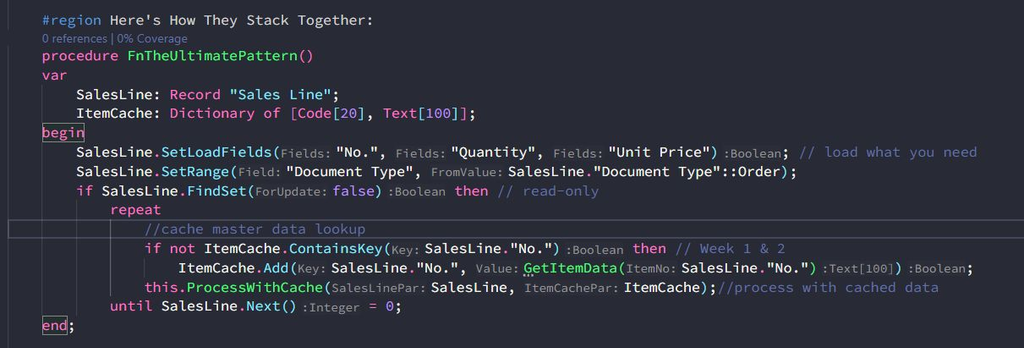
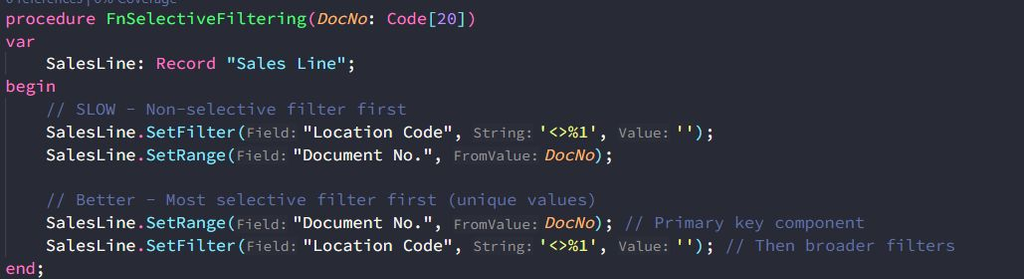
To achieve optimal performance…
Over the past month, we have covered performance optimization techniques. Today, let’s see how they work together to transform daily operations.
Performance stack
🔹Dictionary and lists for caching
🔹Dictionary for eliminating redundant database calls
🔹SetLoadFields for targeted data retrieval.
🔹FindSet pattern for efficient record Iteration
This set of patterns is great for process improvement. Imagine running a supermarket.
✅ SetLoadFields — Instead of restocking every single item in the store, you only bring out the 3 products customers actually asked for. Less clutter, less lifting, faster service.
✅ Smart filtering — You don’t search the entire warehouse for “milk” – you go straight to the dairy aisle. That’s how indexes work when filters are applied correctly. (Filter Order is critical)
✅ FindSet(false) — Instead of sending a worker back and forth to the warehouse for each customer, you bring out the whole cart of items in one trip.
✅ Dictionary caching — If a customer asks the same question twice (“what’s the price of milk?”), you don’t run back to check again – you just remember the answer. (Know your data volume, memory and database trade-offs)
* For repeated access to same 500 items = cache them
* For one-time access to 50,000 items = don’t cache, stream process
* Caching records could consume excessive memory depending on the volume.
Common Mistakes to Avoid:
– Using Find(‘-‘) instead of FindSet
– Not using SetLoadFields before large queries
– Caching data that’s accessed only once
– Using FindFirst in loops instead of Dictionary
– ModifyAll inside transaction loops
– Validating fields during bulk operations
The Bottom Line:
Each function is optimized for a specific purpose. To achieve optimal performance, you must use the method that is best suited for a given purpose.
Performance optimization isn’t about one magic trick. It’s about understanding your data flow and applying the right pattern at each step. Small syntax choices in AL code compound into massive performance differences.