The “Get Layout” Bottleneck: Accelerating PDF Generation with Report.SaveAs
Most custom shipping app where generating 500 warehouse pick labels takes time, Telemetry keeps pointing at the data layer, but the query is always perfectly healthy.
The real culprit?
Most systems spend 80% of its time repeatedly invoking the document layout engine inside a loop.
A standard reporting pattern had been dropped straight into a data‑processing routine—completely unaware of how brutally the rendering engine taxes the Middle Tier when called hundreds of times in rapid succession.
⚠️ The Problem: The High Cost Rendering Tax
When you call report rendering logic inside an execution loop, Business Central doesn’t just pull the dataset; it forces the service tier to resolve the full RDL or Word layout schema, apply the metadata, and compile the document bytes for every iteration.
If you are generating files sequentially in an O(n) pattern just to stream them to middleware or a cloud printer, you are burning CPU cycles spinning up the rendering layout engine hundreds of times.
🛠️ The Fix: Dataset Only Extraction Report.SaveAs XML
If you only need the raw, structured data generated by a report’s complex internal AL logic (such as tracking lines or breakdown calculations) to pass to an external API or middleware, skip the layout engine entirely.
By utilizing Report.SaveAs with ReportFormat::Xml, you instruct the platform to execute the report data model triggers but completely bypass the RDL/Word layout processing layer.
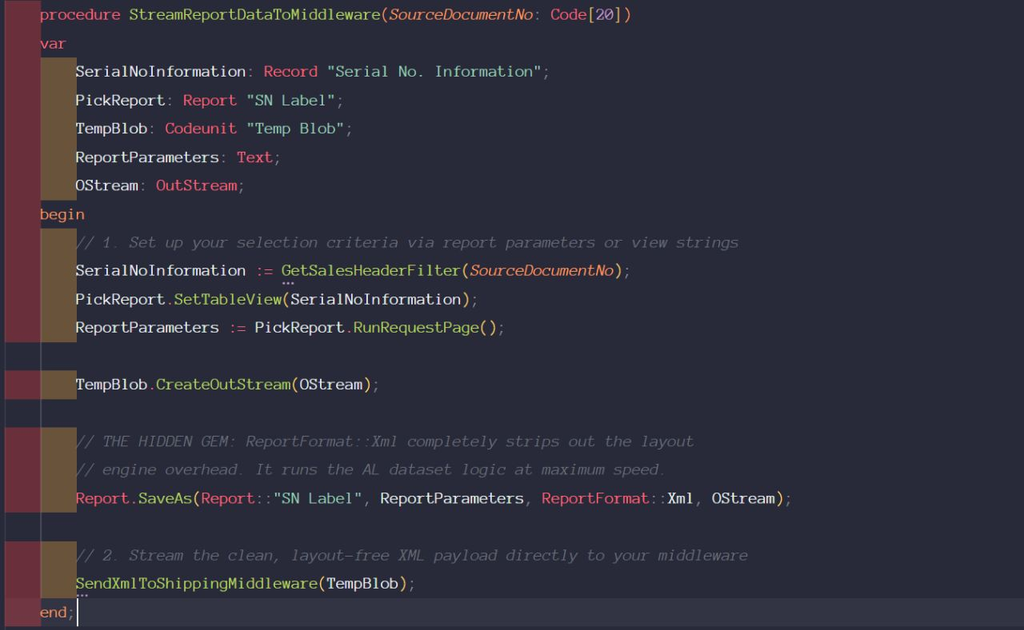
Technical Grounding:
➡️ SaaS Available: Yes.
➡️ Runtime/Upgrade: Runtime.
➡️ Bypasses Triggers: No, it fires all standard report data item triggers (OnAfterGetRecord, etc.), but skips layout rendering.
Why It Matters
✅ Sub-Second Throughput: Bypassing the document layout compilation drops execution time for heavy data extractions down to raw SQL-to-XML speed.
✅ Reduced Memory Footprint: Eliminates the risk of running out of memory on the middle tier when handling massive record sets that would otherwise bloat a visual layout container.
✅ Pure Data Separation: Ideal for modern headless architectures where an external service or middleware handles the final visual styling of labels or documents.
☣️ The Trap: If your external system actually needs the formatted visual representation (like a raw PDF to display to an end-user), this won’t work, you’ll have to pay the layout tax or pre-calculate totals using a standard Query object instead.
✴️ The Bottom Line
If you don’t need a layout, don’t render one. Your integrations get faster, your service tier breathes easier, and your users feel the difference.