The “Session Context” Leak: Why WorkDate Collides in Multi-User Jobs
I audited a posting service where background job queues kept hitting lock timeouts during peak hours, even though transactions were short and indexes were tight.
The hidden culprit? Developers were calling “Session.SetWorkDate()” inside loops. That adjustment leaks into the shared NST thread pool forcing cache invalidations and collisions on setup table locks.
⚠️ The Problem: The implicit environment mutation tax.
Calling WorkDate(NewDate) or altering session context parameters in AL updates the global session state for that specific NST worker thread.
When running high-volume, multi-session integrations or job queues, mutating session-level settings forces the runtime to repeatedly clear operational cache buffers. Even worse, if downstream event subscribers rely on WorkDate(), they execute business logic against an unexpected temporal context, triggering unindexed queries on historical ledgers and forcing SQL server to lock setup schema rows across parallel sessions.
🛠️ The Fix: Explicit context passing over session mutation.
Never mutate the active session’s WorkDate() or global environment settings to pass operational dates down a call stack. Instead, decouple your architecture by passing explicit context parameters directly into your posting routines or wrapping execution logic within isolated parameters.
If you must calculate dates, pass the target posting date explicitly to table validation triggers rather than overriding the environment’s WorkDate.
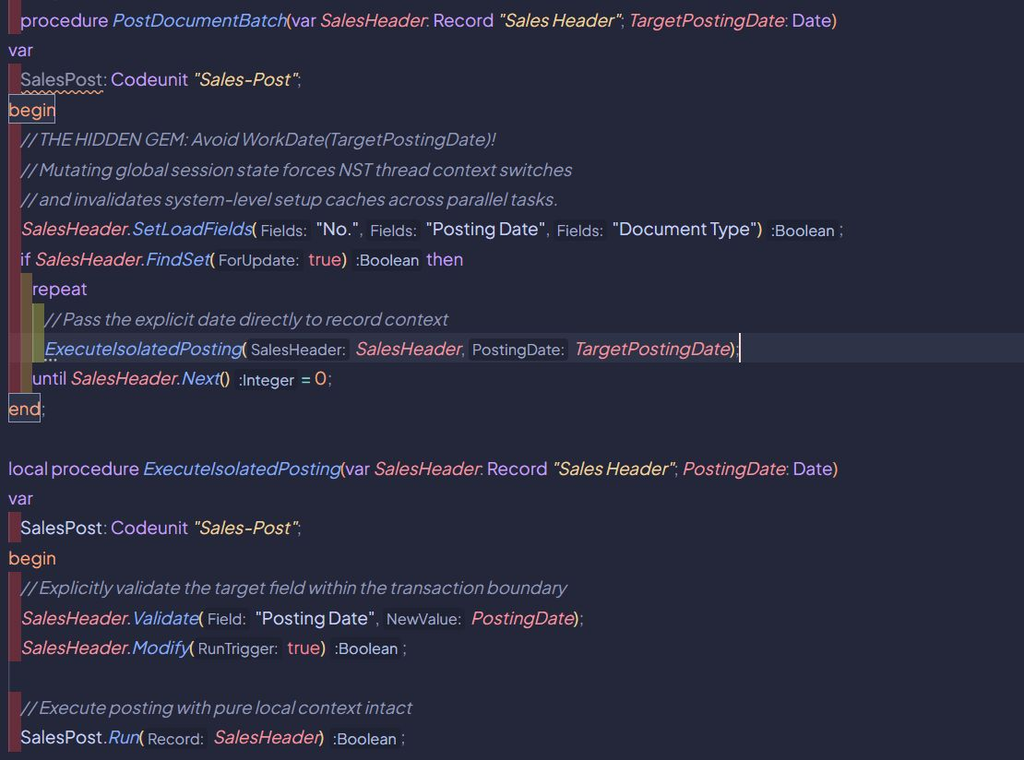
Technical Groundings :
➡️ Saas Avaialble : Yes.
➡️ Runtime/Upgrade : Runtime.
➡️ Bypasses Triggers : No, explicit parameters fire standard validation triggers without polluting session level state.
Why it matters :
✅ Thread Safe Concurrency : Prevents parallel Job Queue sessions from invalidating each other’s NST setup caches, eliminating phantom SQL lock contention.
✅ Deterministic event behavior : Ensures upstream and downstream event subscribers execute against predictable environment state without silent date drift.
✅ Lower telemetry noise : Cuts out mysterious TableLock warnings on core setup tables (General Ledger Setup, Sales & Receivables Setup) in Application Insights.
☣️ The Trap :
If third-party AppSource extensions rely strictly on WorkDate() inside uncustomizable posting subscribers, pass the context via a temporary setup parameter or SingleInstance context codeunit rather than mutating global session state.
💡 The Bottom Line :
Global session state is shared infrastructure. Keep your operational context explicit in your procedure signatures, and leave the session environment untouched.