The “CalcSums” Memory Leak: Why Summing In-Memory Buffers Triggers Silent SQL Seeks.
A payroll engine was calculating gross earnings across thousands of temp lines. The developer assumed TempRecord.CalcSums(“Amount”) would run fully in‑memory fast, LINQ‑style.
Reality check: under certain conditions, unindexed CalcSums on temporary tables forces the NST runtime to hit disk‑backed TempDB, creating massive I/O overhead in O(n) loops.
⚠️ The Problem: The Fake in-Memory Illusion
Temporary tables in AL feel like pure in-memory constructs, but the Business Central Service Tier manages large temporary buffers by backing them with SQL TempDB structures when row counts scale or complex keys are evaluated.
When you call CalcSums() on a temporary record variable without setting an explicit key matching your sum requirements, the platform cannot evaluate a SIFT bucket in RAM. Instead, it issues repeated, single-threaded aggregation passes over the TempDB dataset. In a high-volume loop, this generates hundreds of unnecessary intermediate calculation passes.
🛠️ The Fix: In-Memory Dictionary Aggregation
Instead of relying on TempRecord.CalcSums() inside posting loops, maintain an explicit Dictionary of [Code[20], Decimal] to aggregate running totals in pure Middle-Tier RAM.
By pairing modern Dictionary data structures with temporary staging tables, you achieve true O(1) lookup and addition speeds,completely bypassing TempDB query compilation.
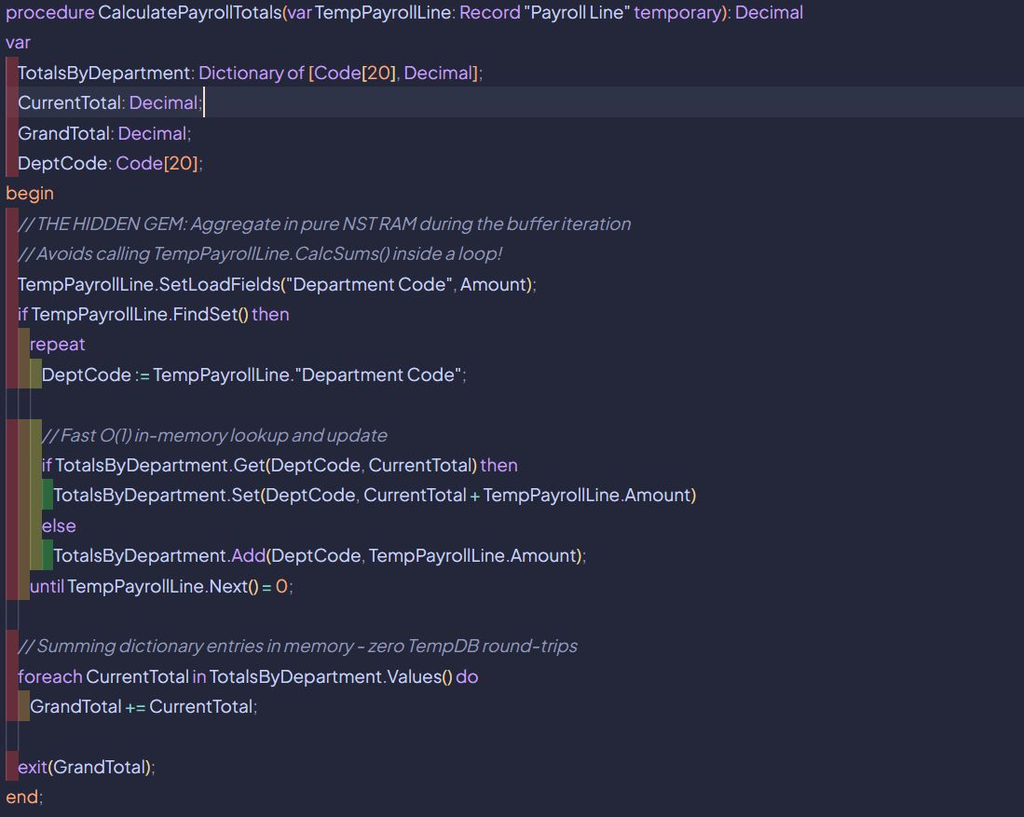
Technical Grounding:
➡️ SaaS Available: Yes.
➡️ Runtime/Upgrade: Runtime.
➡️ Bypasses Triggers: Yes, dictionary calculations operate strictly in NST memory without touching table triggers or SQL contexts.
Why It Matters
✅ True O(1) Aggregation: Eliminates repetitive TempDB iteration passes, keeping Middle Tier CPU utilization virtually flat during batch processing.
✅ Zero SQL TempDB IOPS: Prevents temporary buffer operations from overflowing onto database disk storage in SaaS environments.
✅ Deterministic Execution: Guarantees sub-millisecond calculation speeds regardless of how large the temporary dataset grows during runtime.
☣️ The Trap
Dictionaries live only in active session memory. If your session crashes or throws an unhandled error, those in-memory totals vanish instantly, no rollback, no inspection.
💡 The Bottom Line
Never assume temporary tables are “free.” They still carry database overhead. Keep your fast-path math inside native middle‑tier structures like dictionaries, and reserve TempDB for actual record buffers.