The “TableRelation” Memory Tax: Why Dynamic Lookups Stall Large Pages
A logistics workspace I audited had a simple posting page taking 4-6 seconds to open. No loops. No legacy code. Nothing suspicious in OnOpenPage. The real culprit?
A custom line table packed with conditional TableRelation rules. Every row rendered on screen triggered multiple schema‑validation lookups across six different tables. The data binding engine was doing a full relationship evaluation per row, turning a lightweight page into a slow, memory-heavy grind.
⚠️ The Problem: The implicit SQL round trip tax
Conditional TableRelation logic looks harmless, but it isn’t. When you embed dynamic relations directly on table fields, Business Central must evaluate those relationships during UI rendering and field validation.
If a list page shows 50 lines, the platform evaluates the target relations for every visible cell, not once, but repeatedly.
On dense list pages or API pages, this becomes a silent avalanche of SQL round‑trips before the user can even touch the page.
🛠️ The Fix: Deffered lookup resolution via Page.RunModal & Page level controls
Strip complex conditional TableRelation properties off non-essential storage fields if they exist purely for UI navigation. Instead, enforce integrity in business logic code units and handle specialized lookups dynamically on the page control using OnLookup.
By moving relationship evaluation from the database schema level to explicit UI events, you prevent the NST runtime from proactively querying relations during standard dataset fetch loops.
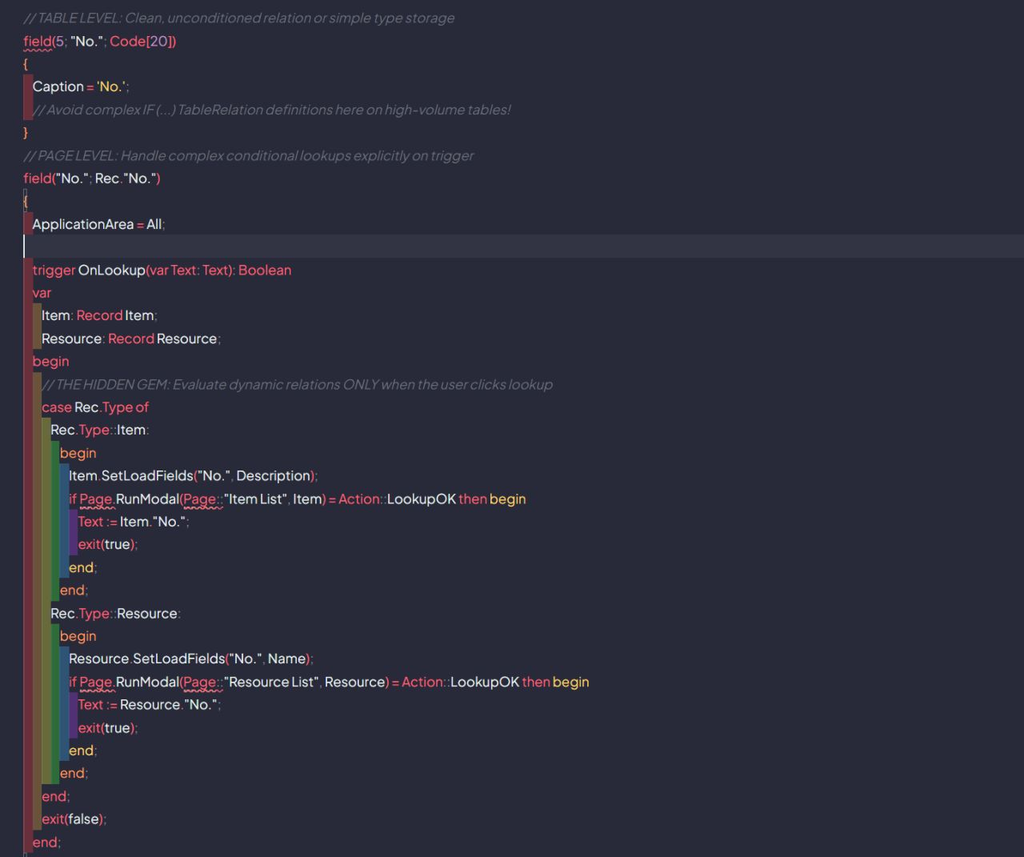
Technical Grounding:
➡️ SaaS Available: Yes.
➡️ Runtime/Upgrade: Runtime.
➡️ Bypasses Triggers: No, moving relation checks to code units/page events allows explicit control over when validation and trigger logic fire.
Why It Matters.
✅ Instant Page Rendering: Eliminates dozens of implicit SQL metadata checks during list layout initialization, cutting page load time dramatically.
✅ Lean NST Memory Footprint: Prevents the Middle Tier from caching relational trees for conditional tables that the user never actually inspects.
✅ Surgical Query Control: Couples perfectly with SetLoadFields on target lookup pages, ensuring zero unnecessary fields are fetched during the lookup action.
☣️ The Trap:
Removing TableRelation from the table schema removes native platform referential integrity checks on field validation, you must explicitly validate input values in your table/codeunit business logic to prevent orphan records.
💡 The Bottom Line
Don’t force your database engine to evaluate table relationships for rows a user is only scanning past. Keep schema definitions lean, and execute relational lookups on demand.