The FlowField Inflation Trap. Why Simple Filters Force Hidden Table Joins
Batch posting 5,000 warehouse entries should not take 20 minutes. Yet telemetry often points to routines like CalculateInventoryTotals() that look harmless on paper.
Here is the catch, calling CalcFields(“Inventory”) on the Item record forces SQL to compute totals across potentially millions of ledger entries. Even with filters applied, this can trigger heavy aggregation scans that balloon execution time.
⚠️ The Problem: Unconstrained flowfield evaluation.
FlowFields in Business Central are pure SQL magic, but they are a double-edged sword. When you call CalcFields() without strictly scoping the underlying FlowFilter fields (like Location Filter, Date Filter, or Global Dimension Filter), the NST engine compiles a SQL query that aggregates all historical data across the entire table.
In high-volume databases, evaluating an unconstrained SumIndexField forces SQL Server to scan unindexed parameter spaces. Doing this inside an O(n) loop turns a fast background batch into a CPU-choking bottleneck.
🛠️ The Fix: Surgical FlowFilter Scoping
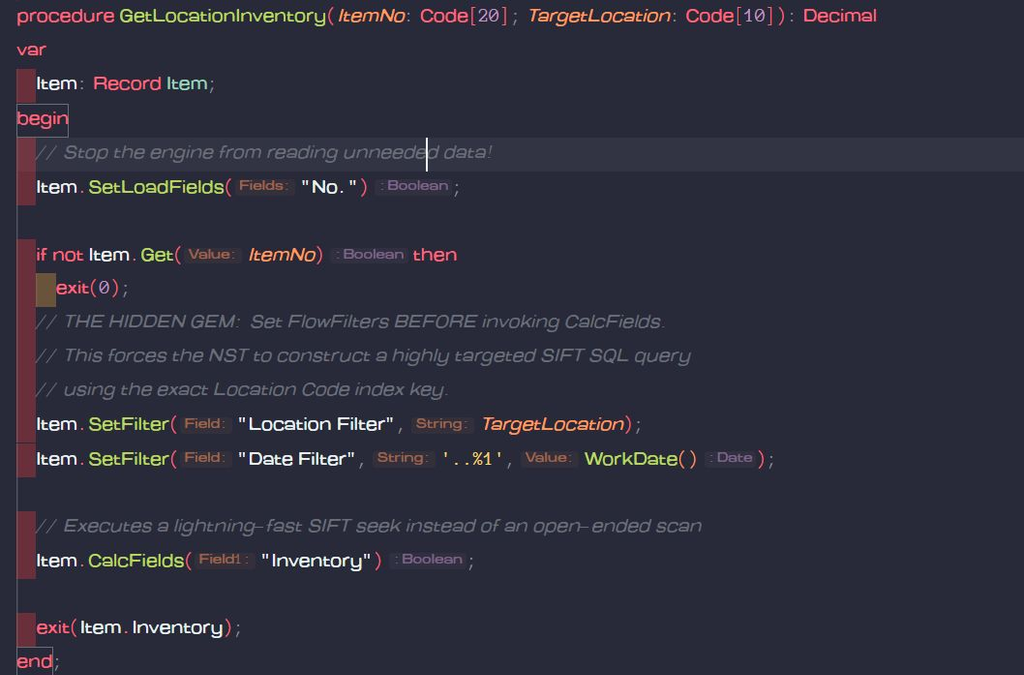
Before triggering CalcFields(), always constrain the record’s FlowFilters to the narrowest possible operational scope. If you only care about a specific location or date range, set those filters explicitly on the parent record first. This allows the SQL query optimizer to leverage exact SIFT index paths rather than executing broad aggregate scans.
Technical Grounding
✅ SaaS Available: Yes.
✅ Runtime/Upgrade: Runtime.
✅ Bypasses Triggers: No, it exclusively optimizes the underlying SIFT SQL query generation.
Why it matters
▫️ Surgical SIFT Seeks: Guides SQL Server directly to pre-aggregated SIFT bucket totals, cutting execution time from seconds to milliseconds per call.
▫️ Reduced Buffer Pool Churn: Prevents millions of unneeded Item Ledger Entry rows from polluting the database memory cache.
▫️ Minimal SQL Lock Footprint: Eliminates wide SQL index scans that trigger shared locks and block concurrent warehouse operations.
☣️ The Trap
Setting a FlowFilter on a field that is not part of the underlying SIFT key definition will cause BC to fall back on an unindexed SUM query. Always verify that your SIFT index on the target table actually includes your filter dimensions.
💡 The Bottom Line
Flow fields are loaded weapons. Use them sparingly, cache results when you can, and never drop them inside tight loops. Treat every CalcFields call as a potential performance tax, precision beats brute force every time.