Temporary tables.
They function as in-memory record variables, resembling regular tables while remaining independent of the database. Perfect for staging datasets, applying complex filters, and minimizing query repetition.
The Problem
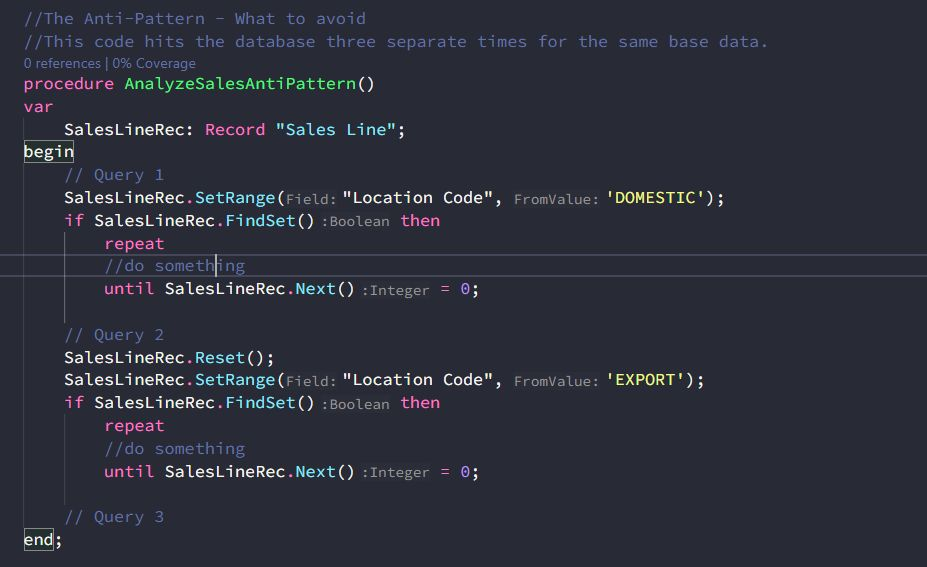
Repeated querying of the database and applying multiple filters to the same data poses a significant performance issue. Example report on Domestic sales, Export sales, High-value orders.
The Fix
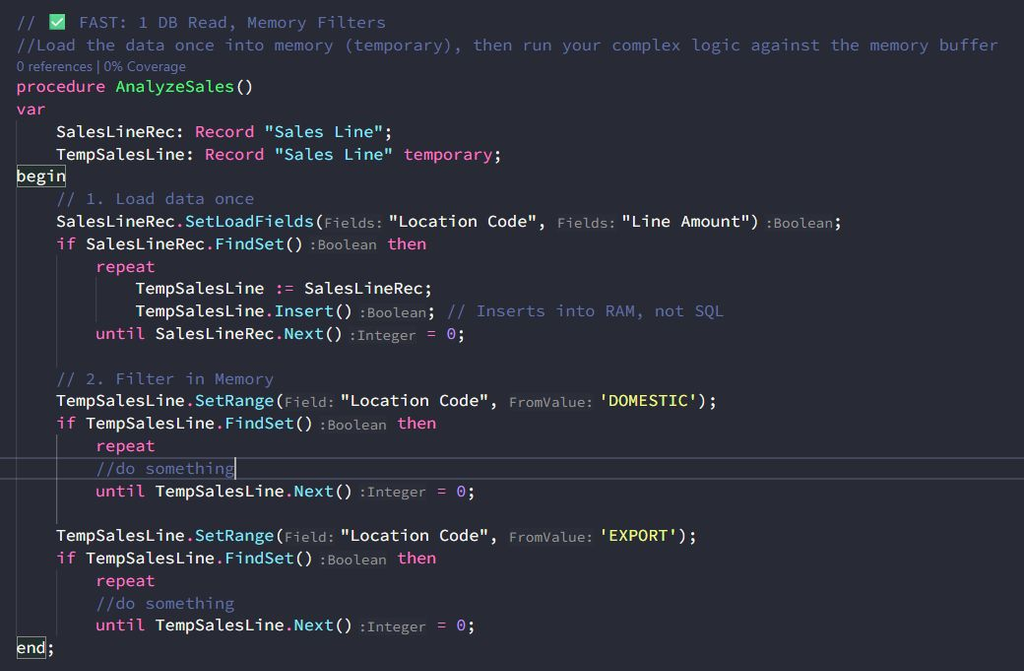
Switch to a temporary table approach – Load once, filter many times. This works better because database queries carry a high cost, whereas memory access is significantly cheaper.
💡 Two key points to keep in mind
1. Triggers – Temporary tables don’t automatically fire OnInsert, OnModify, or OnDelete. If your logic depends on these, you’ll need to invoke them explicitly or use Insert(true) to run triggers.
2. Volume – Since temporary tables live in memory, they’re well-suited for moderate workloads. However, when pushed to very large datasets, performance and stability can quickly become a concern.
📌 When to Use Temporary tables
✅ Multiple passes over the same data – Sort differently, filter differently, aggregate differently
✅ Complex business logic filtering.
✅ Data transformation before processing.
✅ Preview/validation before commit – Show user what will happen, let them confirm.
✅ Cross-table aggregation – Combine data from multiple sources.
🛠️ Usage Tips
➡️ Use existing table definitions, rather than creating custom records.
➡️ Copy records efficiently – Simple assignment copies all fields.
➡️ Temporary tables have full record functionality.
The Bottom line
Database queries are costly. Memory is fast.
If you need to filter, sort, or analyze the same dataset multiple times, load it once into a temporary table.
Formula for speed –
1 database read + many in-memory operations = huge performance gains.
Think of temporary tables as your staging area, use them to cut down redundant SQL calls.
🛠️ Challenge: Spot a report or function that queries the same table repeatedly with different filters. Refactor it to use a temporary table, then share how much faster it runs.